

Meet the candidates who say they’re ready to replace Andy Harris. Each received the same questionnaire at the same time. Responses and accompanying stories based on their answers are published in the order they were returned.
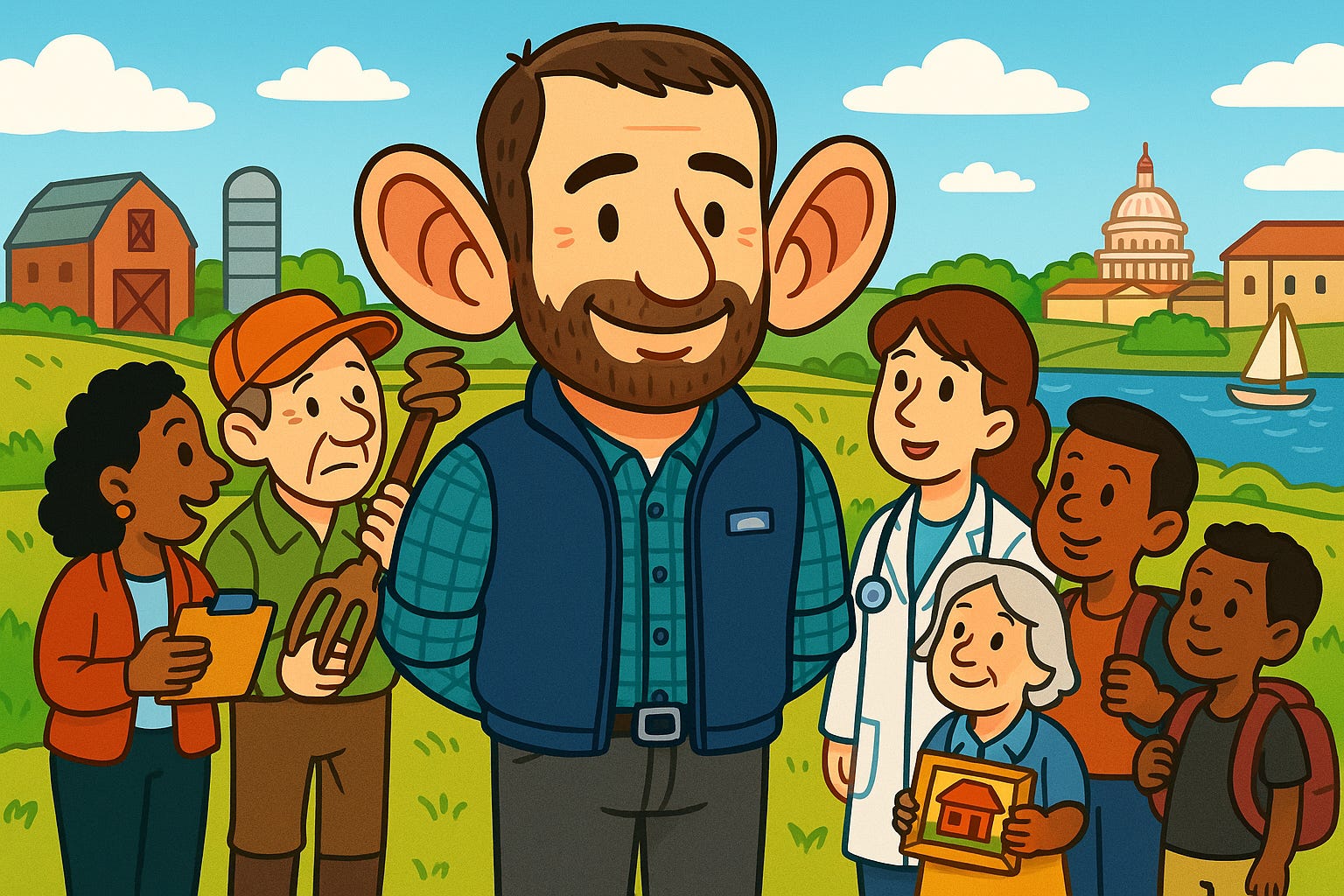
Dan Schwartz is running for Congress in Maryland’s 1st District because, in his view, the incumbent, Rep. Andy Harris, has stopped listening. “Families in the First Congressional District deserve a representative that will listen,” Schwartz said. “Someone that will consistently show up for them and work for them—instead of someone that ignores them and works only for special interests.”
Schwartz says his campaign is rooted in both personal conviction and professional experience. His story starts as a teenager when he started engaging in the field that would become his profession. After attending George Washington University, he interned on Capitol Hill for then-Representative Chris Murphy. In the aftermath of the financial crisis, Schwartz began working for state financial regulators, helping implement Dodd-Frank reforms. He spent a decade at the Conference of State Bank Supervisors and later focused on enforcement actions against “shady actors in the payments industry,” including crypto.
For over a decade, Schwartz worked at the Conference of State Bank Supervisors, collaborating across state lines and with federal agencies like the CFPB, Treasury, and the executive branch. He later focused on enforcement efforts, particularly targeting shady actors in emerging markets such as the payments and crypto industries.
“A key takeaway from my career is the need for government to find a balance between regulation and commerce that allows for local economic development,” he said. “Democrats have not always been great at this. In some areas, we have over-regulated and failed to address key issues of our time: affordable housing, transportation, our aging infrastructure.”
Schwartz argues that the First District is already paying the price for governmental dysfunction, especially as federal staffing and support in Maryland has dwindled. He points to friends and former colleagues at FEMA, the NIH, and the CFPB who have been laid off, despite serving roles he calls vital to public safety and consumer protection. One CFPB staffer, he says, was let go in a mass reduction in force despite “working every day to protect people from scams and fraud.”
“Our government serves an important role in people’s lives,” he said. “We need a government that works for the people, not against the people.”
A New Challenger to the “Big Beautiful Bill”
At the top of Schwartz’s policy platform is his opposition to what Andy Harris and other conservatives have labeled the “Big Beautiful Bill,” a sweeping economic measure that Schwartz sees as a Trojan horse. “I will work to address it by supporting the repeal of the BBB on day one,” he said. “Most Americans see through the scam our congressman voted for. Permanent cuts for billionaires paid for with cuts to food aid for hungry kids and health care for our most vulnerable. They throw out bones like ‘no tax on tips’ and hope that no one looks at the fine print.”
Schwartz says the bill raises taxes on households earning under $90,000 annually, cuts Medicaid, reduces funding for rural hospitals, and harms working families already struggling with rising prices. “The BBB will rip resources away from our rural hospitals on the Eastern Shore,” he said. “Most families in the district will see their federal taxes increase under the BBB.”
He also tied the legislation to a broader weakening of the public sector, saying that funds intended for flood prevention and bay infrastructure have been slashed or redirected. “The administration has taken funds that Congress purposefully approved for bay-related flooding or bridge repair projects and describes those projects as waste and abuse.”
Communities like Crisfield and Oxford, he warned, are already on the brink. “Our District is home to some of the country's first actual climate refugees—folks who have had to leave Smith Island or other bay islands as water levels have risen dramatically. Bay-side communities like Crisfield and Oxford could face the same fate without critical interventions.”
Farmers Left Behind
Schwartz’s campaign has a strong rural focus, driven in part by stories from farmers like his neighbor John, a 68-year-old grower facing unprecedented challenges. “He told me that for the first time in his career, he can’t get a crop in the ground,” Schwartz said. “Fertilizer costs are up due to the tariffs. His largest tractor is broken and the replacement part is made in Ukraine.”
According to Schwartz, John and other local farmers scheduled a meeting in D.C. with Congressman Harris to plead for support. “Several hours passed before they were told, ‘the Congressman is too busy to meet with you today.’ This is how our Congressman and other professional politicians do business. They put special interests before our farmers and our families.”
He faults Harris for supporting agriculture appropriations that he says miss the mark, and offers alternatives: increased support for diverse crops, expanded and streamlined farm credit programs, and lifting restrictions that prevent farmers from repairing their own machinery.
“Tariffs are threatening every industry that calls MD-1 home,” Schwartz added. “The Eastern Shore counties in the district rely heavily on tourist spending, and due to the administration's actions, the USA is expected to lose billions of dollars in tourist spending this year alone.”
Climate and the Bay
Protecting the Chesapeake Bay is one of Schwartz’s top environmental priorities. He supports full funding for NOAA, investment in flood mitigation, and policies that tie environmental stewardship to economic survival.
“We need to secure protections for communities like Crisfield that are vulnerable to flooding,” he said. “We need to fully fund NOAA and weather services given the growing frequency of extreme weather events. We need to work with farmers and other industries in MD-1 to ensure that the Bay stays clean so it can be enjoyed by future generations.”
Schwartz accused the administration of undermining the Bay’s long-term health by gutting science and infrastructure programs. “They’ve fired scientists at the Oxford NOAA lab and zeroed out funding to address flooding in coastal bay communities.”
Reform, Accessibility, and Accountability
If elected, Schwartz says his office will prioritize constituent service and accessibility. “Our district is 90 minutes from the U.S. Capitol. Our representative should be even more accessible than most because of that local proximity.”
He pledges to hold monthly in-person town halls and provide services in multiple languages. “My office will be a welcoming place to all of the district’s residents. In our campaign, we’ve focused on connecting with vulnerable communities across the district and are making sure we have campaign materials available in multiple languages.”
Transparency and ethics reform are central to his platform. “Members of Congress should not be able to leverage information they get from private briefings to profit off of their positions,” he said. “This is insider trading and should be treated as such.”
He’s also launching a youth advisory council, which he plans to leverage through out his campaign and term in office. “I like to surround myself with people who are smarter than me and empower them to do their jobs,” he said. “Having a diversity of viewpoints is important.”
A Bid to Bridge the Divide
To win in a historically red district, Schwartz says he must reach beyond party lines. “The Freedom Caucus extremism of our Congressman is wearing thin on many of the conservatives in the District and across the state,” he said. “It’s wearing thin on folks like my neighbor John, the farmer.”
He’s already visiting counties like Caroline, Worcester, and Cecil in an effort to engage “concerned conservatives” and others. “We’re going to get their stories out on social media, direct mail, billboards, etc. We’re going to do a 100x better job at retail politics than our Congressman, who won’t even show up to talk to farmers who have voted for him in the past.”
Asked to describe the values guiding his campaign, Schwartz listed: “Integrity, transparency, honesty, self-awareness, tolerance, patience, and understanding.”
And when it comes to policy, he says, the solutions are rarely found in soundbites or slogans. “The answers are almost always in the middle,” Schwartz said, “in nuanced understanding of the issues at hand.”